Timeline of a
Paradigm Shift
Fifteen years of Chinese corporate AI launches, mapped against the U.S. export-control regime and China's governance stack. Three parallel clocks that reveal the conditions under which capability, compliance, and distribution became interdependent.
Three Clocks
A timeline shows sequencing, not causation. What this one reveals is the conditions under which three forces evolved in the same room.
Read vertically, you see each track on its own. Read horizontally, you see how Chinese corporate launches, U.S. export controls, and Chinese regulation moved against each other in real time. Capital, cloud position, GPU access, and founder execution also mattered. The book makes the full argument.
Product launches, model releases, and infrastructure milestones from Baidu, Alibaba, Tencent, ByteDance, DeepSeek, Moonshot, and Zhipu.
BIS rules, entity-list additions, and semiconductor restrictions issued by the US Department of Commerce targeting advanced compute.
Regulations and standards from CAC, MIIT, TC260, SCNPC, and the State Council. Procurement, provincial pilots, and SOE adoption also shape outcomes; those are not on this clock.
Machine learning deploys at national scale before "AI" exists as a product category.
First corporate deep-learning research lab in China; Andrew Ng joins as chief scientist the following year.
Establishes data localization, critical information infrastructure, and security review doctrine that later governs AI.
AI becomes user-visible: conversational interfaces enter Chinese homes via smart speakers.
National strategy: aspiration and incentive, not command-and-control.
First in the Ernie (文心) foundation-model family; Chinese pre-training begins in earnest.
First major restriction on a Chinese tech champion; semiconductor exposure becomes national concern.
Largest Chinese-language dense model at release; signals foundation-model ambition.
Personal Information Protection Law and DSL complete the data-governance tripod alongside the 2017 CSL.
Not a Chinese launch; triggers the 2023 pivot across the entire domestic industry.
First advanced-compute rule: restricts Nvidia flagship GPUs, EDA tools, and fab equipment to China.
First AI-specific regulation: mandates algorithm filing with CAC for public-opinion-shaping systems.
First Chinese generative AI service cleared for public release under the Interim Measures. The book's Ch15 claim: compliance architecture became product architecture.
Alibaba Cloud enters the foundation-model race; 100+ LLMs announced across H1 2023.
October 2022 workaround chips banned; performance and interconnect thresholds tightened.
Governs synthetic media, deepfakes, and generative content; requires labeling and identity verification.
Permission structure, not prohibition. Seven agencies co-issue; security assessment and model filing required.
Mixture-of-experts efficiency breakthrough; price war on API inference begins.
671B MoE trained on a reported $5.6M compute budget; minimal domestic filing with global distribution.
High-bandwidth memory and 140+ Chinese fab-tool firms added to restrictions.
TC260 operationalizes the Interim Measures with technical compliance checklists for model filing.
Reasoning model matching frontier performance. One strategy the regulatory architecture makes viable: open-weight global release with minimal domestic filing.
Incorporated in Singapore. The book reads this as a third path alongside Baidu (compliance-as-distribution) and DeepSeek (open weights); tax, fundraising, hiring, and market factors also shape such choices.
Tiered country-level access to advanced AI compute and model weights; universal licensing for frontier models.
Consolidates prior regulations into a unified risk-classification and governance architecture.
Read vertically: three clocks. Read horizontally: one market.
A timeline shows sequencing, not causation. What it reveals is the conditions under which capability, compliance, and distribution became interdependent. Capital, cloud position, GPU access, and founder execution also mattered. The book argues the linkage is systematic.
-
01
Read the clocks together.
Any single track is misleading on its own. Analysts who track only US controls, or only Chinese regulation, or only corporate launches miss the interaction effect that actually shaped 2023 to 2025.
-
02
Regulation sorts, it does not kill.
Baidu, DeepSeek, and Manus illustrate three outcomes of the same regulatory architecture. Compliance-as-distribution, open-weight release, and jurisdictional flexibility are all live strategies in 2025.
-
03
Sequencing is not causation.
This visual reveals conditions. Capital access, cloud position, GPU stockpiling, enterprise sales capacity, and founder execution also mattered. The book tests which of these were load-bearing. The timeline shows you where to look.
This timeline is the architecture of a five-act story.
Every event on this timeline sits in a chapter. The book traces the mechanism, the evidence, and the counter-arguments. Each act below is a chapter cluster in From Lab to Life.
Origins
China's AI dominance began as commercial necessity, not a top-down research project. Baidu and others built terabyte-scale ML systems to serve search and online-to-offline super-apps.
Governance
The shift from unregulated growth to the four-agency Regulator Stack. Algorithm filing became a mandatory engineering deliverable.
Adaptation
U.S. chip export controls forced radical efficiency: DeepSeek's Mixture-of-Experts, FP8 quantization, and accelerated adoption of Huawei's Ascend domestic hardware.
Deployment
This is where the climax lives. The Ernie Bot launch in August 2023 is Chapter 15. The book reconstructs the sixteen-day sprint that followed the Interim Measures taking effect.
Diffusion
Chinese firms bypass domestic constraints by exporting open-weight models and bundled infrastructure to Southeast Asia, the Middle East, and Africa, exporting governance norms alongside the technology.
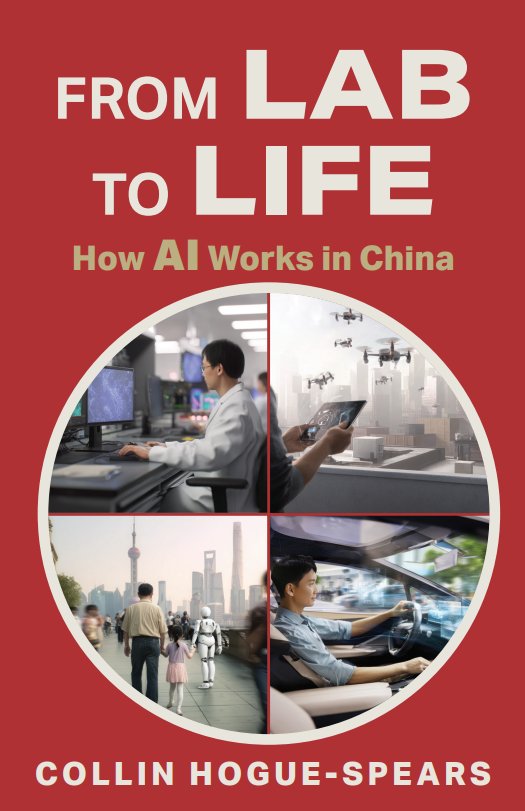
From Lab to Life
A mechanism-level operational manual for the world's second-largest AI ecosystem. June 2026.
Built from primary Chinese-language regulatory texts, company filings, and technical documentation. Drawing on the CAC algorithm filing registry, MIIT licensing publications, MPS cybersecurity grading standards, SAMR enforcement decisions, and corporate disclosures from Baidu, Alibaba, ByteDance, Tencent, and DeepSeek.